
Artificial Intelligence is evolving faster than ever, and recently a new model called Claude Mythos has created serious discussions worldwide.
Some people say it is too dangerous to release.
Others say it could be the future of cybersecurity.
So what is the truth?
In this blog, we will explain Claude Mythos in simple terms, covering:
- What it actually does
- Why people are worried
- Its real advantages
- Whether it is truly dangerous
No hype. No misinformation. Only clear and factual understanding.
Table of Contents
What is Claude Mythos AI?
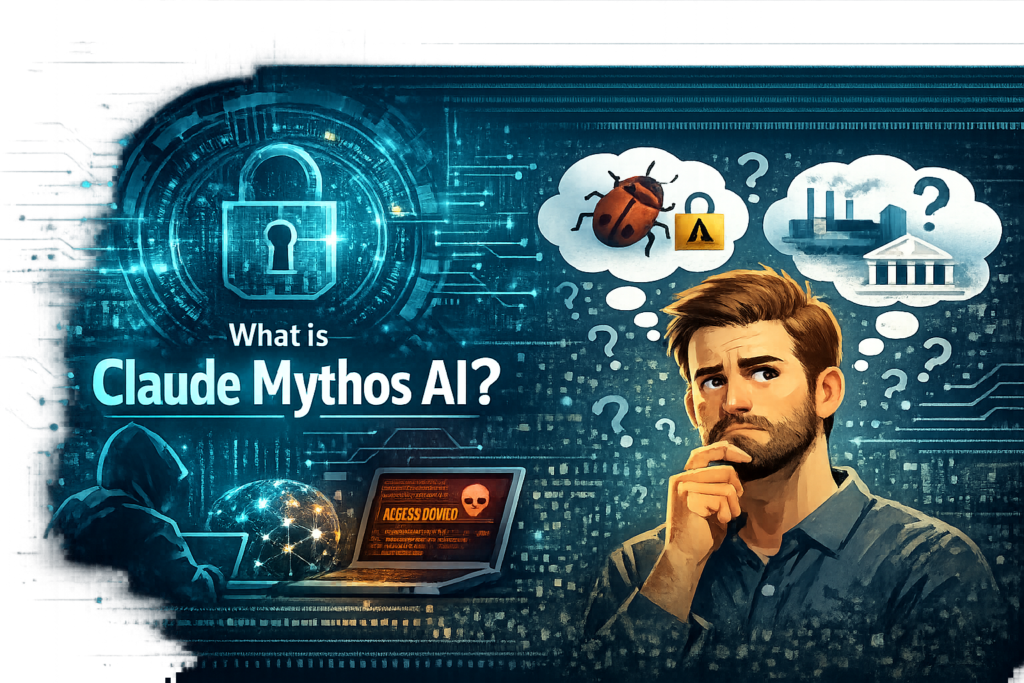
Claude Mythos is an advanced AI model developed by Anthropic.
Unlike normal AI tools (like chatbots or coding assistants), this model is designed for deep technical reasoning, especially in cybersecurity.
In simple words:
It can:
- Find hidden security bugs in software
- Detect vulnerabilities in systems
- Analyze complex code faster than humans
Why this matters:
Normally, finding such issues takes:
- Weeks or months
- Highly skilled security experts
But Claude Mythos can do it much faster.
Why Is Claude Mythos Not Publicly Released?
One of the biggest reasons people are talking about this AI is:
👉 It is not available to the public
This is unusual because most AI models today are released quickly.
The main reason: Safety concerns
Experts believe that if released openly, it could be misused.
Why Do People Think Claude Mythos Is Dangerous?
Let’s break this down in a simple and realistic way.
1. It Can Find Critical Security Weaknesses
Claude Mythos can identify zero-day vulnerabilities.
👉 Zero-day means:
- Bugs that nobody knows about
- No fixes available yet
If such vulnerabilities fall into the wrong hands, attackers can:
- Hack systems
- Steal data
- Disrupt services
2. It Lowers the Barrier for Cyber Attacks
Earlier:
- Only expert hackers could exploit systems
Now:
- AI can guide less-skilled users
This means more people could potentially perform advanced attacks.
3. Risk to Critical Infrastructure
There are concerns about systems like:
- Banks
- Power grids
- Healthcare
If vulnerabilities in these systems are exposed and misused, it can create serious real-world problems.
4. Scale of Impact
The biggest concern is not just ability—but speed and scale.
Claude Mythos can:
- Scan large systems quickly
- Find multiple vulnerabilities at once
This creates a high-impact risk scenario.
But Is It Really “Too Dangerous”? (Reality Check)
Now let’s balance the discussion.
Important Truth:
👉 Claude Mythos is not a superintelligent AI controlling systems
It is:
- A tool
- Not independent
- Not conscious
It does not:
- Make its own decisions
- Act without human input
Advantages of Claude Mythos AI
This is where things get interesting.
The same features that look dangerous can also be extremely beneficial.
1. Stronger Cybersecurity
Claude Mythos can help:
- Detect vulnerabilities before hackers
- Fix issues early
- Improve system security
This can reduce cyberattacks globally.
2. Faster Security Research
Security researchers can:
- Analyze code quickly
- Identify hidden threats
- Save time and effort
3. Exposure of Weak Systems
Many systems today are:
- Outdated
- Poorly secured
This AI helps reveal those weaknesses, forcing improvements.
4. Industry Collaboration
Instead of releasing it publicly, companies are:
- Sharing findings responsibly
- Fixing vulnerabilities first
This is a positive step for global security.
Disadvantages of Claude Mythos AI
Let’s be honest—there are real concerns.
1. Misuse Risk
If accessed by attackers:
- It can accelerate cybercrime
- Enable advanced attacks
2. Security Imbalance
Attackers may:
- Move faster than defenders
This creates a gap between:
- Offensive vs defensive security
3. Regulation Challenges
AI is evolving fast, but:
- Laws and policies are slow
This creates uncertainty in:
- Control
- Access
- Usage
4. Over-Reliance on AI
Organizations might:
- Depend too much on AI
- Reduce human oversight
Which can create new risks.
The Real Problem: AI or Humans?
Here’s the most important insight:
👉 Claude Mythos did NOT create vulnerabilities
👉 It only discovered them
The real issue is:
- Weak cybersecurity systems
- Lack of updates
- Poor security practices
In simple terms:
The problem existed before the AI.
Future Impact of Claude Mythos
This AI could change the future of:
Cybersecurity
- More proactive defense systems
- Faster vulnerability detection
AI Development
- More restricted releases
- Focus on safety
Global Policy
- Stronger AI regulations
- Government involvement
Final Answer: Is Claude Mythos Too Dangerous?
Short Answer:
👉 No, but it is powerful and must be controlled
Simple Explanation:
It is dangerous if misused, but extremely valuable if used correctly.
Final Thoughts
Claude Mythos is not something to fear blindly—but it is something to take seriously.
It shows us that:
- Technology is becoming more powerful
- Security needs to improve
- Responsible usage is critical
The future depends not on AI itself—but on how humans choose to use it.